











MELAKA
Melaka
Melaka and its state capital, Melaka City is widely dubbed as Malaysia’s historical city. This historical city centre has been listed as a UNESCO World Heritage Site in July 2008. With a total land area of only 1,664 square kilometres, this city is serviced by the Melaka International Airport is located in Batu Berendam with easy 2-hour driving access from Kuala Lumpur to its north.
Contact Info
- Melaka Forestry Department
- webjpnmelaka@forestry.gov.my
- http://forestry.melaka.gov.my
- PERHILITAN Tanjung Tuan Department of Wildlife and National Parks, Melaka
- melaka@wildlife.gov.my
-
EVENT: Raptor Watch – March (Annual Event)
Malaysian Nature Society (MNS) - events@mns.org.my
-
www.raptorwatch.org
www.mns.my
Tanjung Tuan Forest Reserve and Wildlife Sanctuary
No. of species: > 100
Tanjung Tuan houses Malaysia’s oldest lighthouse, built originally in the 1500s and is one of the few remaining primary coastal rainforest areas on the West Coast and on a clear day, enjoy the panoramic view of the coast, its coral reef’s and birds.
There are over 100 bird species have been spotted here, including forest birds and migrating raptors. From late February to March, some of the migratory raptors you might see here include the Black Baza, Eastern Honey-Buzzard, Grey-faced Buzzard, Greater Spotted Eagle as well as the Chinese Sparrowhawk and Japanese Sparrowhawk. Forest birds that may be seen here include the Changeable Hawk-eagle, Large Green pigeon, Oriental Dollarbird, Coppersmith Barbet, Greater Flameback, Black-naped Oriole, Blue-throated Bee-eater and the Asian Glossy Starling.
The lighthouse service road takes you up to the top of the 95 metres hill and much of the birding can be carried out along it. This is a pleasant walk with a good chance to spot some interesting birds such as Oriental Paradise-flycatcher (Blyth’s Paradise- Flycatcher), Crimson Sunbird and during winter migration season, Orange-headed Thrush is a possibility.
Tanjung Tuan is accessible by communal busses from the town of Port Dickson, which is a 45minute drive from the city of Seremban or by taxi and rented car if you are travelling from the Kuala Lumpur International Airport. It will take you about 1.5-hour to reach the site. This is truly an all-round ecotourism site for birdwatchers and wildlife enthusiasts, suitable for all levels of fitness and age groups.
Tanjung Tuan Recreational Forest
Species Count : +130 bird species.
Habitat : The site includes extensive mudflats and a mangrove belt of roughly 600 hectares, stretching from the mouth of Abdul River at Bagan Belat up to the northern coastline at Dataran Tsunami Kuala Muda. There are mangrove forests along the coast, intertidal zones, river mouths/estuaries, and tidal flats which are exposed during the low tide. These provide feeding and resting grounds for shorebirds.
Visitor Experience : Birdwatching at Tanjung Tuan is most famous for its annual Raptor Watch season (February to April), when thousands of raptors — including Oriental Honey-buzzards, Black Bazas, and Japanese Sparrowhawks — soar overhead as they return northwards.
Potential Bird Sightings :
Black-eared Barbet, Dark-necked Tailorbird, Olive-winged Bulbul, Greater Racket-tailed Drongo, Lineated Barbet, and Blue-throated Bee-eater.
Migratory Birds (August–March) : Oriental Honey-buzzard, Black Baza, Chinese Sparrohawk, Grey-faced Buzzard, and Japanese Sparrowhawk.
Malacca Botanical Garden (Ayer Keroh Recreational Forest)
No. of species: 135
A beautiful forest complex, this site is one of easiest access sites in the country for visitors to get a glimpse of the megadiversity of Malaysia. Situated just off the North-South Highway, Malacca Botanical Garden or formerly known as Air Keroh Recreational Forest is about 15 kilometres from Melaka town and 2-hour drive away from Kuala Lumpur city.
Some of the over 135 bird species found here include lowland forest birds such as the Black-thighed Falconet, Jambu Fruit-dove, Oriental Paradise-flycatcher (Blyth’s Paradise-Flycatcher), Purple-naped Spiderhunter, Pink-necked Green-pigeon, Thick-billed Green-pigeon, Stork-billed Kingfisher, Banded Kingfisher, Blue-eared Kingfisher, Sunda Pygmy, Buff-necked, Buff-rumped, Crimson-winged and Rufous Woodpecker, Coppersmith Barbet, Gold- whiskered Barbet, Red-crowned Barbet, Rusty- breasted Cuckoo (Brush Cuckoo), Changeable Hawk-eagle and Crested Serpent-eagle. There are also 3 owl species here, namely Barred Eagle-owl, Buffy Fish-owl and Brown Wood-owl.
There is also a lake and fringing locations within the site that will be interesting in terms of bird life and even interesting wildlife.
Batang Tiga Rice Fields
Species Count : +150 bird species.
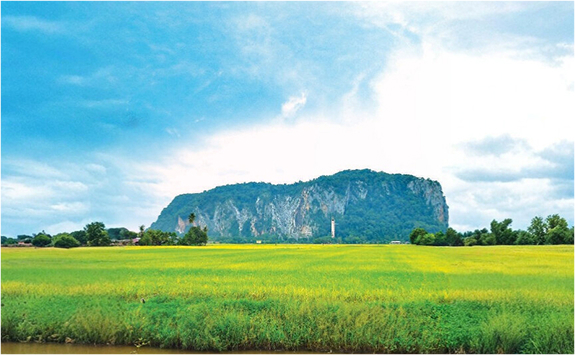
Habitat : The landscape is dominated by seasonally flooded rice paddies interspersed with grassy levees, drainage channels, and occasional patches of scrub and scattered trees.
Visitor Experience : Birdwatching at Batang Tiga is best done by slowly driving or walking along the network of narrow field roads and bunds, which offer close and unobstructed views of birds.
Potential Bird Sightings :
Purple Heron, Lesser Adjutant, Lesser Coucal, White-throated Kingfisher, Paddyfield Pipit, and Eurasian Moorhen.
Migratory Birds (August–March) : Oriental Reed Warbler, Black Drongo, Eastern Marsh Harrier, and Black Bittern.
Sungai Rambai Paddy Field
Species Count : +120 bird species.
Habitat : The site is characterized by expansive rice paddies interspersed with drainage ditches, shallow ponds, grassy levees, and scattered trees.
Visitor Experience : Birdwatching at the Sungai Rambai is typically done by walking or slowly driving along the network of bund roads and dirt tracks that crisscross the fields.
Potential Bird Sightings :
Lesser Whistling Duck, Little Egret, Grey headed Swamphen, Red-wattled Lapwing, Lesser Adjutant, Eurasian Moorhen, and Long-tailed Shrike.
Migratory Birds (August–March) : Little Ringed Plover, Oriental Pratincole, Brown Shrike, Red-Throated Pipit, Black Drongo, and Tufted Duck.